How to Create a Dating App in 2026: Costs, Core Features, and the Market Research That Comes First
How Dating Apps and Sites Make Money in 2026: Proven Monetization Strategies
December 15, 2025How to Create a Dating Website in 2026: Steps, Features, and Costs
January 6, 2026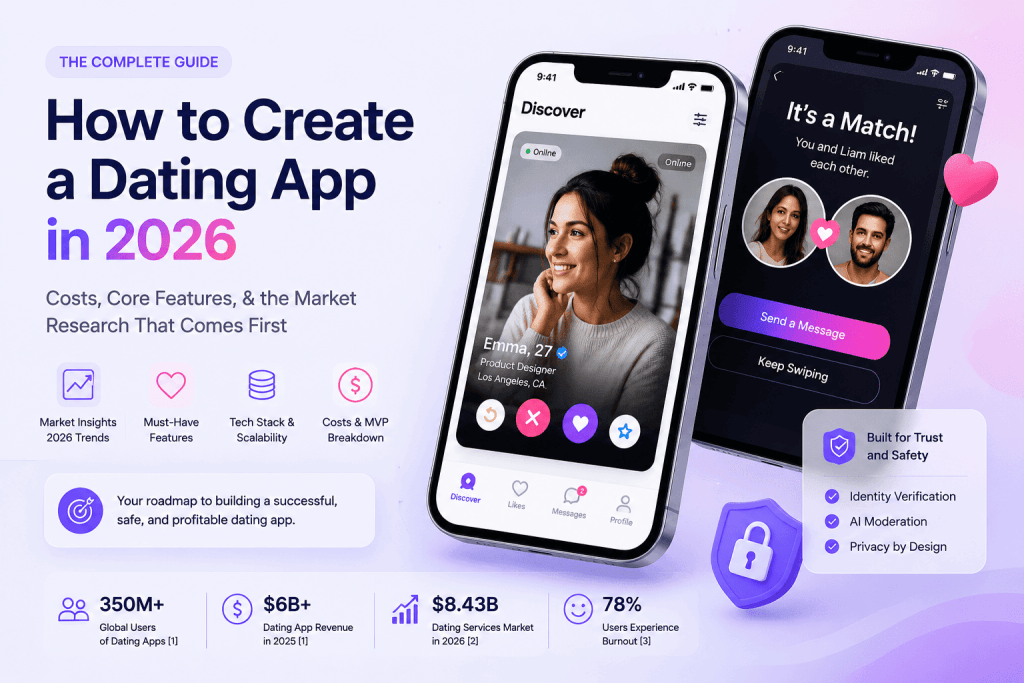
Estimates of the online dating market vary depending on what each source includes. Dating apps generated just over $6 billion in revenue in 2025, with more than 350 million users worldwide and approximately 23 million people paying for premium features.[1] Statista's broader Dating Services category, which also includes matchmaking and casual-dating services, is projected to generate $8.43 billion in 2026.[2] These figures should not be treated as a single continuous market estimate because they use different definitions. Meanwhile, a Forbes Health/OnePoll survey found that 78% of dating app users experienced dating app burnout, although the finding comes from a U.S. consumer survey rather than a global study.[3]
At the same time, niche-focused, safety-first, and AI-assisted dating platforms are attracting interest from users looking for alternatives to broad swipe-based products. Statista projects average revenue per user of approximately $13.10 for the broader global Dating Services market in 2026, though actual revenue varies by geography, audience, pricing model, and how "active user" is defined.[2]
If you're trying to figure out how to create a dating app that people will actually use and pay for, market research comes before market development. This guide walks through both, plus the core features, timelines, and real costs behind a 2026 launch.
How to create a dating app, in six steps:
- Validate the market and confirm real demand for your idea
- Choose a niche narrow enough to name in one sentence
- Build a lean MVP: profiles, matching, messaging, nothing more yet
- Add trust and safety before launch, not after
- Launch on the App Store and Google Play
- Scale acquisition and retention once the core experience holds up
The rest of this guide is the detail behind each of those six steps.
Table of contents
- Market Overview 2026
- Key Market Trends Shaping Dating Apps in 2025–2026
- Choose a Niche and Truly Understand Your Audience
- Craft Your Unique Value Proposition
- Core Features Every Dating App Needs in 2026
- Tech Stack and Database Setup for a Scalable Dating App
- How to Create a Dating App: MVP Timeline 2026
- Dating App Development Cost 2026 - Full Breakdown
- Publishing on the Apple App Store and Google Play
- Custom vs Turnkey Solution (SkaDate) - Full Comparison
- Security and Testing Before Launch
- Monetization Strategies That Work in 2026
- User Acquisition, Marketing, and Retention in 2026
- Legal & Compliance Requirements 2026
- Common Mistakes Founders Make Building a Dating App
- Conclusion and Next Steps
- FAQ
- Sources
Market Overview 2026
| Metric | Latest supported estimate | Scope |
|---|---|---|
| Dating app revenue | Just over $6 billion in 2025 | Mobile dating apps |
| Global dating app users | More than 350 million | Worldwide |
| Paying users | Approximately 23 million | Premium-feature payers |
| Dating Services revenue | $8.43 billion projected for 2026 | Broader Statista category |
| Dating Services CAGR | 1.64% projected for 2026–2030 | Broader Statista category |
These come from different research categories and methodologies[1][2] - read them as separate estimates, not one continuous trend line.
The paying-user figure is the one worth paying attention to. Only a relatively small share of dating app users pay for premium features, which means the commercial opportunity depends less on total registrations than on creating enough value for a defined audience to subscribe or make in-app purchases. For new entrants, a smaller group of engaged paying users may be more valuable than a much larger but passive audience. That is the commercial logic the rest of this guide is built around.
Validate Your Dating App Idea
Explore your target audience, core features, and the right development approach before investing in development.
Key Market Trends Shaping Dating Apps in 2025–2026
Understanding the numbers is only half the picture. The real opportunity lies in knowing why the market is shifting, and where the gaps are opening up for new entrants.
The mainstream swipe model is under pressure. The dating app market recorded its first annual revenue decline in 2025, falling by close to 2% to just over $6 billion[4]. Tinder generated approximately $1.8 billion in 2025, a 5.2% decline from the previous year[5]. Bumble also saw declining revenue and paying-user numbers in 2025, though it reports different operating metrics than Tinder, so the two aren't directly comparable[6][7]. A Forbes Health/OnePoll survey found that 78% of dating app users experienced burnout[3]. Users are not necessarily abandoning online dating altogether; many are becoming less patient with repetitive, high-volume experiences that fail to produce meaningful outcomes.
Some niche platforms are growing while larger apps face pressure. Grindr reported first-quarter 2026 revenue of $130 million, an increase of 38% year over year, and raised its full-year revenue outlook to at least $535 million[8]. PURE reported $100 million in annual gross revenue, 95% year-over-year growth in registrations, and 46% revenue growth at the end of 2025, according to figures released by the company itself[9]. These examples do not prove that every niche app will outperform a mainstream platform, but they show that products built for a clearly defined audience can grow even when parts of the broader market are contracting.
Adults aged 30-49 remain an important audience. In a nationally representative 2026 SSRS survey, 53% of U.S. adults in this age group said they had used an online dating service at some point, while 8% identified as current users. By comparison, 10% of adults aged 18–29 and 2% of adults aged 50 or older were current users[10]. This doesn't tell us about conversion rates for this group, but it shows online dating usage extends well beyond the youngest demographic.
Gen Z is not using dating apps exclusively for casual connections. In a Forbes Health/OnePoll survey, 52% of Gen Z respondents said that finding a long-term relationship was their primary goal when using dating apps, compared with 49% of millennials and 47% of both Gen X and baby-boomer respondents[3]. This is a finding from a consumer survey rather than a universal measure of Gen Z behavior, but it challenges the assumption that younger users are interested only in casual encounters. Products emphasizing clearer intentions, safety, and meaningful compatibility may therefore appeal to part of this audience.
There is a second layer to what younger users want, and it is not limited to matching mechanics. Unclear intentions, repetitive interactions, and uncertainty about who is behind a profile can all contribute to dating app fatigue. Prompt-based profiles, verification tools, and optional voice or video communication can help users gather more information before deciding whether to meet. This is not simply a question of casual versus serious dating; it is about helping people establish trust and determine more quickly whether a connection is worth pursuing.
Monetization per paying user matters as much as audience growth. Match Group reported that revenue per payer reached $20.90 per month in Q1 2026, an increase of 10% year over year, while the number of payers declined 5% to 13.5 million[11]. Statista separately projects global ARPU of $13.10 for the broader Dating Services market in 2026[2], but the two measures are not directly comparable: Match Group reports revenue per payer, while Statista's ARPU is calculated across a broader user base and market category. For a new app, the practical implication is that engaged paying users may matter more commercially than a large passive audience.
The window of opportunity isn't closing. It's shifting. Building another general-purpose swipe app is a 2018 strategy running on 2026 assumptions. What works now is specificity — a defined audience, a clear reason to pay, an experience that feels genuinely different from Tinder. The trends above are the brief. What follows is the roadmap.
Choose a Niche and Truly Understand Your Audience
Building a dating app can involve different matching models (geolocation, questionnaire-based, or traditional catalog approaches), but the real opportunity right now lies in niche-based solutions. Standing out in a crowded dating market means focusing on a specific segment where you can address needs a mass-market app was never built to handle. Instead of competing head-to-head with the giants, start by researching where interest is actually moving, using tools like Google Trends and social listening, to spot rising lifestyle categories such as veganism, gaming, or travel before the competition catches up.
Understanding your audience matters just as much as picking a label for it. Identify the pain points - generic interactions, no personalization, safety concerns nobody addressed - and get specific about what people in this niche actually want. Are they after deep compatibility built on shared values, or mainly a platform where they feel safe enough to be honest? Surveys, small focus groups, and time spent in the niche's own online communities will tell you more than any competitor teardown.
| Niche 2026 | Why It Works | Example Audience |
|---|---|---|
| Vegan & Plant-Based | Builds authentic connections around strong ethical and health values. Users appreciate judgment-free conversations and a shared lifestyle, which may support trust and retention. | Vegans, vegetarians, flexitarians, sustainability-focused individuals |
| Gaming & Esports | Gamers spend hours online and want partners who understand their culture, schedule, and references. In-app events, shared streams, and voice features can create additional reasons to return to the app. | Hardcore gamers, esports enthusiasts, casual gamers, tech-savvy Gen Z |
| Travel & Digital Nomads | Appeals to adventure seekers who want flexible, location-independent connections. Ideal for users tired of local-only matching and seeking global compatibility. | Frequent travelers, digital nomads, backpackers, adventure seekers |
| Fitness & Active Lifestyle | Aligns with the ongoing wellness boom. Shared challenges, workout logs, and activity-based matching make it easier to move from chat to a real-life date. | Gym enthusiasts, runners, yoga lovers, CrossFit athletes, sports fans |
| Pet Lovers | One of the warmest, most emotionally engaging niches. Pets create instant icebreakers and trust, and may make it easier to start conversations. | Dog parents, cat lovers, exotic pet owners, animal rescue enthusiasts |
| Sober & Mindful Dating | Rising fast alongside the broader sobriety and wellness trend. Users want meaningful connections without alcohol pressure, and the niche stands out for authenticity. | Sober-curious individuals, sober daters, wellness enthusiasts, recovery community |
| Neurodivergent-Friendly | Addresses communication styles, energy levels, and sensory needs often misunderstood in mainstream apps. Reduces burnout, creates a more inclusive and respectful environment. | ADHDers, autistic adults, neurodivergent individuals and their allies |
Pick the niche where market research shows real, underserved demand, not just enthusiasm. A niche with three competing apps already fighting for the same 50,000 users is a much harder starting point than a niche with none.
Craft Your Unique Value Proposition
A dating app that just reproduces swipe-and-match with a new coat of paint won't hold anyone's attention past week two. Three pillars tend to separate a successful dating app from a forgettable one.
Deep Personalization. Use more than age and location. Hobbies, values, and actual user behavior make for suggested matches that feel considered rather than random, and users notice the difference almost immediately.
Community-Centric Design. Groups, shared events, and discussion threads give people a reason to open the app even when they aren't actively looking for a match right now. That turns a dating tool into something closer to a community, which is where retention actually comes from.
Robust Safety Features. In an online dating app, trust is everything. Rigorous profile verification and proactive tools to catch toxic behavior aren't optional extras; they're what separates an app users recommend from one they quietly delete.
Get these three right for a specific audience, and the value proposition takes care of itself. It stops sounding like "another dating app" and starts sounding like the dating app for this particular group of people, which is exactly the positioning that lets a new entrant compete with players who have ten times the marketing budget.
Core Features Every Dating App Needs in 2026
Most dating apps, regardless of niche, need three things at minimum: user profiles, a matching mechanism, and messaging. Everything past that is either a differentiator or a distraction, and telling those two apart early saves real money.
| Feature | MVP | Difficulty | Illustrative Custom Cost |
|---|---|---|---|
| Registration & Social Login | Yes | Low | $8–15k |
| Rich User Profiles | Yes | Medium | $10–18k |
| Geolocation & Swiping | Yes | Medium | $12–20k |
| Robust Matching Algorithm (basic) | Yes | High | $25–55k |
| Chat & Communication (text + stickers) | Yes | Medium | $18–35k |
| Push Notifications | Yes | Low | $5–10k |
| Customizable Settings | Yes | Low | $4–8k |
| Admin & Analytics Panel | Yes | Medium | $15–25k |
| Data Security & Privacy (encryption, compliance) | Yes | High | $15–30k |
| ID + Selfie Verification (with liveness) | Yes | High | $15–35k |
| Interactive & Gamification Elements | Yes | Medium | $8–18k |
| AI Compatibility Score / Smart Matching | Post-MVP | Very High | $35–80k+ |
| Voice & Video Calls | Post-MVP | High | $18–40k |
| Virtual Gifts & Boosts | Post-MVP | Medium | $8–15k |
| AI Content Moderation (toxicity detection) | Yes | High | $12–25k |
These figures are illustrative development estimates rather than fixed market prices. Actual cost depends on product scope, technical architecture, design complexity, third-party services, compliance requirements, development rates, and the amount of existing functionality that can be reused.
Registration & Login. Social sign-in or Google login, verified phone numbers, and an onboarding flow that gets a new user to their first match in just a few minutes, not a ten-screen questionnaire. Every extra step here loses users you'll never get back.
Rich User Profiles. Photos, bios, interests, lifestyle details. Integrating platforms like Instagram or Spotify adds signal without asking the user to type more.
Robust Matching Algorithm. Blend mathematical, behavior-based, and location-driven approaches to generate connections that feel meaningful rather than random. A purely rules-based algorithm feels stale fast, and behavior-based signals are the usual next step. Once sufficient high-quality behavioral data is available, machine-learning models can be tested against static rules. Whether they perform better should be determined through controlled evaluation rather than assumed in advance.
Chat Functionality. Real-time messaging, built on WebSockets, Firebase, or a service like Twilio, is what turns a match into an actual conversation. A message that takes three seconds to send is enough friction to send users to a competitor's app instead.
Geolocation & Swiping. GPS-based proximity matching plus swipe mechanics that stay fast and intuitive even as your user base and server load grow into the tens of thousands of concurrent users.
Push Notifications. New matches, new messages, profile views, timed right rather than constantly, are what re-engage users who haven't opened the app in two days. Get the frequency wrong and you'll train people to swipe away the notification without reading it.
Data Security & Privacy. This is where trust either gets built or quietly destroyed. Password hashing, secure account recovery, access controls, encryption in transit and at rest, data-retention rules, breach-response procedures, and careful management of third-party services should be addressed before launch. End-to-end encryption may be appropriate for some messaging implementations, but it is not a universal requirement imposed by GDPR or the CCPA. GDPR applies when the product processes personal data within its territorial scope, while the CCPA applies only to businesses that meet the law's scope and threshold requirements.
ID + Selfie Verification. Liveness-checked verification before a profile goes live, rather than after complaints roll in, is the single feature niche audiences ask about most. It's also comparatively cheap against what a trust failure costs in churn.
Admin & Analytics Panel. Not glamorous, but this is what lets a founder catch churn weeks before it shows up in revenue.
One small feature worth building in from day one: let users undo a swipe. People misfire when they're nervous or distracted, which is often. SkaDate's own matching tools, My Type and Searches, exist for exactly this reason: they give people enough control that a mismatch feels like their own choice rather than the algorithm's mistake.
Field note - features that rarely pay off first. Nearly every founder who comes to us wants AI compatibility scoring and gamification built before the basic matching algorithm even works well. It's backwards. A mediocre algorithm with great gamification still produces bad matches, just with a badge on them. Get the core matching and verification solid first; the AI layer and the gamified extras earn their cost only once the basics already retain users.
Choose the Right Features
Review the available matching, communication, monetization, moderation, security, and administration tools before defining your MVP scope.
Tech Stack and Database Setup for a Scalable Dating App
Choosing scalable technologies early avoids a rebuild later, when you can least afford the downtime. A dating app's tech stack generally splits into four layers, and getting the database setup right matters more than most founders expect going in.
Mobile. React Native is a popular framework for cross platform development, letting one codebase ship to both iOS and Android. Flutter is the other common choice, with similar trade-offs.
Backend. Node.js is commonly used for backend development in dating apps because it handles many concurrent users and real-time events without falling over. NestJS on top of it adds structure once the codebase grows past a small team's ability to keep it organized informally.
Database. PostgreSQL and MongoDB are the two databases that show up most often in dating app development - PostgreSQL for structured data like user accounts and subscriptions, MongoDB or a similar document store for flexible data like chat history and profile metadata. Redis usually sits alongside either one for caching, which is what keeps a matching query fast once you're past a few thousand daily active users.
Real-time & AI.Socket.io or Firebase typically handle live chat at scale. Python with a lightweight ML framework is the common choice for an on-device or server-side matching model once you move past a simple rules-based algorithm.
For context, established platforms generally use distributed cloud infrastructure, multiple data stores, caching, event-processing systems, and specialized services for messaging, recommendations, moderation, analytics, and experimentation. The exact stack varies by company and changes over time.
No-code and low-code builders are the third path, alongside custom development and a turnkey platform. FlutterFlow combines visual UI design with backend integration; Adalo does the same for iOS and Android from a single project. Both are genuinely useful for testing an idea and neither carries the compliance or matching complexity a real dating app needs at scale - treat them as prototyping tools, not launch platforms.
How to Create a Dating App: MVP Timeline 2026
Focus on delivering the core features that validate your concept without getting bogged down in unnecessary complexity. Speed and efficiency matter more than completeness at this stage.
| Stage | Custom MVP planning range | SkaDate published estimate |
|---|---|---|
| Market validation and product definition | Varies by research scope | Completed by the founder before configuration |
| Website setup | Varies | Approximately one business day for a default website |
| Google Play publication | Subject to review and revisions | Typically 2–4 weeks |
| Apple App Store publication | Subject to review and revisions | Up to 2–3 months |
| Progressive Web App setup | Varies | Approximately one week after all required information is supplied |
| Custom development | Estimated separately | Depends on requested modifications |
The SkaDate figures above are the company's current guiding estimates and begin only after it receives all necessary setup information. Third-party hosting, customization, and store-review decisions can extend the timeline.
A basic clickable prototype can be created relatively quickly with a visual no-code builder, making it useful for testing flows and gathering early feedback. A launch-ready dating product with reliable matching, moderation, identity controls, payment processing, analytics, and store approval is a substantially larger project. Prototype speed should therefore not be presented as the expected timeline for a production release.
Four things keep an actual MVP timeline honest. Prioritize core features over a longer list; a dating app should launch with profiles, a reliable matching system, and messaging, full stop. Lean on a ready-made platform rather than building profile verification and real-time chat from zero, since that's solved territory and not where your app should differentiate. Launch early and iterate instead of chasing a "finished" version that doesn't exist yet. And keep the UX simple: user feedback consistently shows that dating apps fail more often from clutter than from missing features.
Dating App Development Cost 2026 - Full Breakdown
When planning to create a dating app, the two primary paths are custom app development and a turnkey solution. Each has real trade-offs depending on your budget, timeline, and how much control you actually need over the codebase.
| Approach | Published cost indication | Important qualification |
|---|---|---|
| Custom development | Approximately $70,000–$230,000 | SkaDate estimate based on roughly 2,300 hours and rates of $30–$100 per hour |
| SkaDate Silver Plan | From $799 | Current scope should be confirmed before publication |
| SkaDate Gold Plan | From $1,999 | Current scope should be confirmed before publication |
| Additional customization | Estimated separately | Depends on design, integrations, plugins, compliance and development scope |
| Ongoing infrastructure and operations | Not included in one universal figure | Hosting, moderation, support, verification and third-party services vary by usage |
Published development estimates vary widely because the term "MVP" may refer to anything from a testable prototype to a production-ready application with moderation, verification, payments, analytics, and native mobile releases. SkaDate's own illustrative model for a custom dating app totals approximately 2,300 hours and estimates an overall cost of $70,000–$230,000, depending on hourly rates and project complexity. In that model, the hours are distributed approximately as follows:
| Development phase | SkaDate illustrative hours | Approximate share of total hours |
|---|---|---|
| Analysis & prototyping | 220 | 9.6% |
| Project management | 180 | 7.8% |
| Frontend development | 650 | 28.3% |
| Backend development | 900 | 39.1% |
| QA testing | 250 | 10.9% |
| Deployment | 100 | 4.3% |
| Total | 2,300 | 100% |
Backend and frontend eat two-thirds of the hours between them, which is also where scope tends to quietly expand. Add roughly 10% on top of those two line items as a buffer, because something always runs long.
A typical project team for this scope runs at least two developers, a business analyst, a project manager, a QA specialist, and a designer, all billing hours whether or not the product has found traction yet. Custom development buys total control over the codebase; it costs time and a team that needs active management.
A turnkey platform changes the trade-off by providing registration, profiles, matching, messaging, and administration as an existing foundation. SkaDate's 2026 guide lists a Silver Plan starting at $799 and a Gold Plan starting at $1,999, although the company should confirm the current price and included services before publication. The same guide refers to more than 50 available plugins, while another comparison table on the page says 70+, so the safest current wording is that SkaDate offers dozens of optional plugins for monetization, analytics, moderation, and engagement.
Field note - what founders almost always underestimate. It's rarely the build itself. It's QA and content moderation hours once real users start behaving unpredictably, and the three to six months of hosting, support, and small fixes right after launch, before any revenue has caught up. Budget for the app; then budget again for staying open after it ships.
Compare Launch Costs
Review SkaDate packages, included services, hosting options, and customization rates to estimate a more realistic launch budget.
Publishing on the Apple App Store and Google Play
Getting a finished app onto a phone isn't the last step; it's a checklist of its own, and dating apps face more scrutiny here than most categories.
Apple and Google require apps with user-generated content to provide effective moderation and user-safety mechanisms. Apple's relevant requirements appear under App Review Guideline 1.2, which requires safeguards such as filtering objectionable material, reporting offensive content, blocking abusive users, and providing published contact information[12]. Apple clarified in 2026 that apps with random or anonymous chat are also subject to Guideline 1.2[13]. Google Play similarly requires clear terms of use, an in-app system for reporting objectionable content, and functionality that allows users to block others[14]. Google Play also requires apps offering matchmaking or dating functionality to use Play Console features to block minors[15]. Neither platform provides a universal guarantee of approval or a fixed resubmission period.
Beyond the compliance checklist, App Store Optimization is worth planning before launch. Niche-specific keywords may face less competition and align more closely with the intended audience than broad terms such as "dating app." Test keyword positioning, screenshots, localization, ratings, and store-page conversion rather than assuming that any keyword category will perform better universally.
Once live, apps on both the Apple App Store and Google Play need ongoing attention, including review responses, product updates, store-listing experiments, localization, and regular checks that screenshots and descriptions still reflect the current product.
Custom vs Turnkey Solution (SkaDate) - Full Comparison
| Aspect | Custom Development | SkaDate |
|---|---|---|
| All must-have features | + | + |
| Feature updates | – (extra cost) | + |
| Extra plugins | – (extra cost) | + (dozens of optional plugins) |
| Team experienced in dating niche | – (hard to find) | + |
| Quick time to market | – | + |
| Scalability | + | + |
| Mobile apps for iOS and Android | – (extra cost) | + |
| Dating website | – (extra cost) | + |
| PWA | – (extra cost) | + |
| AI matching module | – (additional custom-development cost) | + (plugin) |
| Lifetime updates | – | + |
| Published starting cost | ~$70k–$230k, SkaDate's illustrative estimate | From $799 in SkaDate's 2026 guide; confirm current package scope |
| Time to launch | Depends on scope, team, and approval requirements | Website ~1 business day; Google Play 2–4 weeks; Apple App Store up to 2–3 months; custom work estimated separately |
Custom development offers full control and extensive customization, but it also requires a larger budget, a dedicated team, and ongoing technical management. A turnkey dating app builder reduces the amount of functionality that must be created from scratch, which can shorten configuration and development time. However, the total launch timeline still depends on customization, testing, third-party services, and Apple or Google review.
Neither path is objectively right. If speed and cost efficiency matter more than owning every line of code, a dating app builder is usually the smarter starting point, with the option to migrate to a custom build once the niche is proven and the budget for it actually exists.
Which path actually fits you?
- Need to validate the concept before committing to development? Start with a prototype.
- Need standard dating functionality with limited custom engineering? Consider a turnkey platform.
- Need to own the codebase or support unusual integrations, workflows, or compliance requirements? Consider custom development.
- Need an enterprise-scale product with specialized infrastructure or regulatory requirements? Build with a dedicated technical team.
The correct choice depends on product requirements, operating budget, ownership needs, and acceptable implementation risk, not on a universal price or timeline threshold.
Field note - the decision that's usually wrong. Founders reach for custom development because it feels more serious, more fundable, more "real." That's a reason to impress an investor, not a reason to build. The right reason to go custom is a specific technical requirement a turnkey platform can't meet - not the feeling that owning the code makes the business
Need a Custom Solution?
Describe your required platforms, features, audience, and project scope to receive an individual development estimate.
Security and Testing Before Launch
App security is where a lot of first-time founders underinvest, right up until the first breach or the first App Store rejection over it.
At minimum, a dating app should use strong password hashing, secure account-recovery procedures, encrypted network connections, appropriate access controls, logging, vulnerability management, and safeguards for sensitive profile and location data. Multi-factor authentication can provide additional protection for administrative accounts and high-risk recovery flows. End-to-end encryption can strengthen private messaging, but it isn't a blanket GDPR or CCPA requirement - the right controls depend on data sensitivity, product architecture, applicable laws, and what a formal security assessment turns up.
User verification and reporting tools do double duty here: they increase user trust and give your moderation team the data to act on. Identity verification specifically, ID plus a liveness-checked selfie, is one of the fastest ways to build trust in a new app that doesn't have years of reputation behind it yet.
Before launch, testing needs to cover more than "does the button work." Performance under load (what happens to server response times once you have a few thousand concurrent users swiping at once) and security vulnerability scanning both belong in the same QA pass as basic usability checks. A dating app that crashes during its first viral TikTok moment loses most of those new users permanently, not temporarily.
Monetization Strategies That Work in 2026
Successful dating apps generate revenue by blending multiple models while keeping the user experience smooth. Implementing monetization that adds value, rather than intrusive fees or ads, is what separates apps users tolerate from apps users actually recommend.
| Model | How It Works | Main Advantage | Main Risk | Common Examples |
|---|---|---|---|---|
| Freemium access | Core matching and communication are free; advanced features are paid | Supports user acquisition and liquidity | Free users may be expensive to serve and difficult to convert | Tinder and Bumble |
| Subscription | Users pay recurring fees for filters, visibility, insights, or an ad-free experience | More predictable recurring revenue | Value must remain clear after the first billing cycle | Hinge, Tinder, and Bumble premium tiers |
| In-app purchases | Users buy one-time boosts, visibility products, or virtual items | Adds incremental revenue without requiring a subscription | Aggressive prompts can damage trust and retention | Boosts, Spotlights, roses, and virtual gifts |
| Credits / pay-per-action | Users purchase credits for specific actions | Flexible in markets where subscriptions are less common | Pricing can feel opaque or transactional | Selected niche and international platforms |
No reliable independent dataset was found that supports a universal revenue share or ARPU range for each model. Results depend on geography, audience, pricing, platform fees, and the definition of an active or paying user.
Freemium. Users get the basics for free - enough to make and receive matches while advanced filtering, unlimited swipes, or enhanced visibility sit behind a paywall. This model is what drives fast user acquisition and gives a new app the volume it needs before any premium tier makes sense.
Subscription. A recurring model that unlocks detailed profile insights, exclusive events, advanced filters, or an ad-free experience. It offers more predictable revenue than one-time purchases, but users need a clear reason to remain subscribed beyond the first billing cycle.
In-App Purchases. One-time boosts to profile visibility or premium messaging capability, good for short-term revenue spikes without asking for a long-term commitment.
Tinder Plus and Gold add unlimited swipes and see-who-liked-you visibility on top of a free core. Bumble Boost prioritizes messaging and profile placement while the base app stays free. Hinge leans almost entirely on subscription, betting that a curated, ad-free experience justifies the price on its own. None of these interrupt the core product to sell something, which is the part worth studying more than the pricing itself.
User Acquisition, Marketing, and Retention in 2026
| Channel | Primary Role | What to Test | Important Limitation |
|---|---|---|---|
| TikTok and short-form video | Generate awareness and test creative positioning | UGC formats, hooks, niche-specific creators and landing pages | CAC varies sharply by geography, creative quality, and attribution window |
| Meta and Instagram | Reach defined demographic and interest groups | Audience segments, creative formats, retargeting, and store-page conversion | Privacy restrictions and attribution gaps can distort reported ROI |
| Referral program | Add trusted, lower-friction acquisition | Incentive structure, fraud controls, and invitation conversion | Results depend on existing engagement and network density |
| App Store Optimization | Improve discovery and store-page conversion | Keyword positioning, screenshots, reviews, and localization | ASO is not free acquisition; measurement should separate discovery from conversion |
Published CAC and ROI figures from a software vendor should be treated as internal planning assumptions, not universal U.S. dating-app benchmarks.
The budget required to acquire the first meaningful cohort of users depends heavily on geography, niche size, local density, creative performance, store-page conversion, referral behavior, and the chosen definition of an acquired user. Rather than planning around a universal cost for 10,000 registrations, start with controlled channel tests, measure verified registrations and activated users separately, and expand spending only after retention and match liquidity show that the product can support additional traffic. Paid acquisition, referrals, partnerships, community outreach, and App Store Optimization should be evaluated as a portfolio rather than as interchangeable sources of installs.
Acquisition gets a new app started; retention is what makes it a business. Push notifications timed around actual behavior, not a fixed schedule, are the simplest lever for turning a signup into a daily active user. Track daily actives against total registered users early: a large registered base with a shrinking daily number is the clearest warning sign that the core experience isn't landing.
Legal & Compliance Requirements 2026
Age access controls: Google Play requires apps with matchmaking or dating functionality to use Play Console features to block minors[15]. Additional age-assurance methods may be required depending on jurisdiction, content, product design, and risk.
User-generated content: Apple Guideline 1.2 and Google Play's UGC policy require moderation, reporting, and user-blocking mechanisms[12][14].
GDPR: Applies to personal-data processing within its territorial scope and requires an appropriate legal basis, transparency, data-subject rights, security, and other safeguards.
EU AI Act: May introduce additional obligations where the product uses systems covered by the regulation; not every matching algorithm is automatically classified as high-risk.
CCPA/CPRA: Applies only where the business falls within the law's scope and includes qualifying consumer rights concerning access, deletion, correction, and certain uses or disclosures of personal information.
Local legal review: Requirements differ by country and may involve consumer protection, subscriptions, biometrics, location data, content moderation, and online-safety rules.
Common Mistakes Founders Make Building a Dating App
These five show up often enough, across enough launches, that they stop looking like bad luck and start looking like a pattern.
Picking a niche that's really just an interest, not an underserved market. "I love hiking, so a hiking dating app" feels like a niche. It isn't one until you've checked whether hikers are actually dissatisfied with how they meet people now, versus just being a group you personally identify with.
Overbuilding the MVP before anyone's paid for the basic version. AI matching, video calling, and a gamified onboarding flow are expensive ways to delay the one question that matters: will this specific audience use profiles, matching, and chat enough to stick around. Answer that first.
Treating verification as a post-launch nice-to-have. It's cheap now and expensive later. A dating app with a fake-profile problem in month two spends the next six months rebuilding trust it never should have lost.
Underestimating the marketing budget, sometimes to zero. A finished app with no acquisition plan may receive a small initial wave of downloads and then go quiet. Development is only one part of the total investment; meaningful growth also requires acquisition testing, community building, referrals, partnerships, and retention work.
Launching with no retention plan at all. Founders plan for the first download and stop there. The apps that make money plan for the tenth day, not the first one; a matched user who never opens the app again was never really a user.
Conclusion and Next Steps
Five decisions carry most of the weight in this whole process, in roughly this order. Research the market and pick a niche narrow enough that you can describe, in one sentence, what mainstream apps get wrong for that audience. Build a value proposition around personalization, community, and safety rather than a longer feature list. Decide between custom development and a turnkey dating app builder based on your actual budget and timeline, not which one sounds more impressive. Ship a lean MVP, gather real user feedback, and resist adding features nobody asked for yet. Fund acquisition and ASO from day one, because the best app in the world doesn't matter if nobody finds it.
None of this guarantees a hit. Skip the niche step, though, and everything downstream gets harder. You end up marketing to everyone, which in practice means marketing to no one in particular.
Whether the plan is a fully custom build or a cost-effective turnkey platform, the next move is the same: start planning with a clear niche and a clear read on what that audience actually needs.
Before you spend a dollar on development, validate these five assumptions: that your niche has people actively unhappy with how they date now, that you can name your value proposition in one sentence, that your real budget covers marketing and not just the build, that you have an honest answer for identity verification, and that you have a plan for day ten, not just day one. Get uncertain about any of those, and that's the one worth resolving before you write a line of code, or sign a contract with anyone who will.
If a turnkey platform fits that budget and timeline, SkaDate already has the profiles, matching, messaging, and moderation built - so the work that's left is configuring it around your niche, not building it from zero. See SkaDate's dating app builder and get started.
See SkaDate in Action
Explore the mobile app, desktop platform, and administration tools before deciding how to launch your dating product.
FAQ
Sources
Footnote numbers below match the bracketed markers in the body text, numbered in the order each source is first cited. Click ↩ to jump back to where you were reading (lettered ↩a ↩b ↩c when a source is cited more than once).
- Business of Apps. "Dating App Revenue and Usage Statistics (2026)." Updated June 11, 2026. https://www.businessofapps.com/data/dating-app-market/
↩a↩b↩c - Statista Market Insights. "Dating Services — Worldwide." https://www.statista.com/outlook/emo/dating-services/worldwide
↩a↩b↩c↩d - Forbes Health / OnePoll. "Forbes Health Survey: 78% Of All Users Report Dating App Burnout." Published July 25, 2025. Updated July 23, 2026. https://www.forbes.com/health/dating/dating-app-fatigue/
↩a↩b↩c - Business of Apps. "Annual Dating App Market Revenues Decline for First Time." Published April 20, 2026. https://www.businessofapps.com/news/dating-app-market-first-annual-revenue-decline/
↩a↩b - Business of Apps. "Tinder Revenue and Usage Statistics (2026)." Updated June 11, 2026. https://www.businessofapps.com/data/tinder-statistics/
↩ - Bumble Inc. "Bumble Inc. Announces Fourth Quarter and Full Year 2025 Results." Published March 11, 2026. https://ir.bumble.com/news/news-details/2026/Bumble-Inc--Announces-Fourth-Quarter-and-Full-Year-2025-Results/default.aspx
↩ - Bumble Inc. "Bumble Inc. Announces First Quarter 2026 Results." Published May 5, 2026. https://ir.bumble.com/news/news-details/2026/Bumble-Inc--Announces-First-Quarter-2026-Results/default.aspx
↩ - Grindr Inc. "Grindr Inc. Reports First Quarter 2026 Revenue Growth of 38%, Raises Guidance." Published May 7, 2026. https://investors.grindr.com/news/news-details/2026/Grindr-Inc--Reports-First-Quarter-2026-Revenue-Growth-of-38-Raises-Guidance/default.aspx
↩a↩b↩c - PURE. "Dating App PURE Hits $100M Revenue with 95% User Growth While Industry Giants Contract." Published January 30, 2026. https://press.pure.app/260351-dating-app-pure-hits-100m-revenue-with-95-user-growth-while-industry-giants-contract/
↩a↩b - SSRS. "The Public and Online Dating 2026." Nationally representative survey of 2,012 U.S. adults, fielded January 2026. Published February 2, 2026. https://ssrs.com/insights/online-dating-2026/
↩ - Match Group. "Match Group Announces First Quarter Results." Published May 5, 2026. https://ir.mtch.com/investor-relations/news-events/news-events/news-details/2026/Match-Group-Announces-First-Quarter-Results/default.aspx
↩a↩b - Apple. "App Review Guidelines." https://developer.apple.com/app-store/review/guidelines/
↩a↩b - Apple. "Updated App Review Guidelines now available" (clarifies that random or anonymous chat apps fall under Guideline 1.2, User-Generated Content). Published February 6, 2026. https://developer.apple.com/news/?id=d75yllv4
↩ - Google Play. "User Generated Content." Play Console Help. https://support.google.com/googleplay/android-developer/answer/9876937?hl=en
↩a↩b - Google Play. "Age-Restricted Content and Functionality." Play Console Help. https://support.google.com/googleplay/android-developer/answer/16302250?hl=en
↩a↩b↩c
Figures attributed to SkaDate are the company's own vendor estimates and should be confirmed against current pricing and scope before publication. Figures attributed to Match Group, Bumble, Grindr, and PURE are self-reported by those companies. The Forbes Health/OnePoll burnout figure (78%) reflects all surveyed users across age groups, not a single generation.
Serial entrepreneur with over 15 years of experience in the online dating industry. He has successfully built and scaled multiple platforms from zero to millions in revenue, including Meetville (Co-Founder, scaled to $5M+ ARR) and Seeking.com (Head of Growth, drove $20M+ in revenue growth).
Alex helps founders build profitable dating businesses, not just apps. He shares playbooks on launching and growing dating products.